Is your CX costing you revenue?
Most organisations can’t answer that with confidence, and the gap is expensive.
The ACTIVATE Framework™ is a structured 8-step methodology for AI-enabled CX transformation, turning fragmented AI investment into measurable commercial growth.
Developed by James McIntyre, Customer Experience & Growth Marketing Leader.
Start with the free diagnostic below: 8 questions, 3 minutes, for a personalised assessment of where your CX is leaking commercial value.
What Is the ACTIVATE Framework™?
The ACTIVATE Framework™ is a structured 8-step methodology developed by James McIntyre for AI-enabled customer experience transformation. It was built from working directly with growth-stage and enterprise brands across Australia including Wesfarmers, Flybuys, Medibank, Ampol and CashRewards.
The framework addresses the core problem facing most organisations today – 95% of generative AI pilots fail to deliver measurable P&L impact, yet 83% of consumers believe customer experience should be better than it is. The gap isn’t technology. It’s the operating model around it.
ACTIVATE provides a structured, sequenced path from AI ambition to commercial outcome, connecting strategy to delivery at every step.
Why Most AI CX Initiatives Don’t Deliver
AI initiatives inside most organisations share the same failure pattern. They are tool-led rather than customer-led. They are siloed within marketing, product or IT. They are measured on engagement, not commercial impact. And they are deployed without clear accountability.
Meanwhile, customers judge AI differently than businesses deploy it. They don’t evaluate sophistication. They evaluate lived experience. Was it faster? Was it fair? Did it respect me?
As a result, small problems become systemic. I worked recently with a retail brand where I uncovered an automation agent delivering over 30,000 off-brand experiences to customers each month – nobody owned it, nobody was measuring it.
Prioritisation separates transformation from experimentation. Governance separates pilots from payback. The ACTIVATE Framework™ provides both.
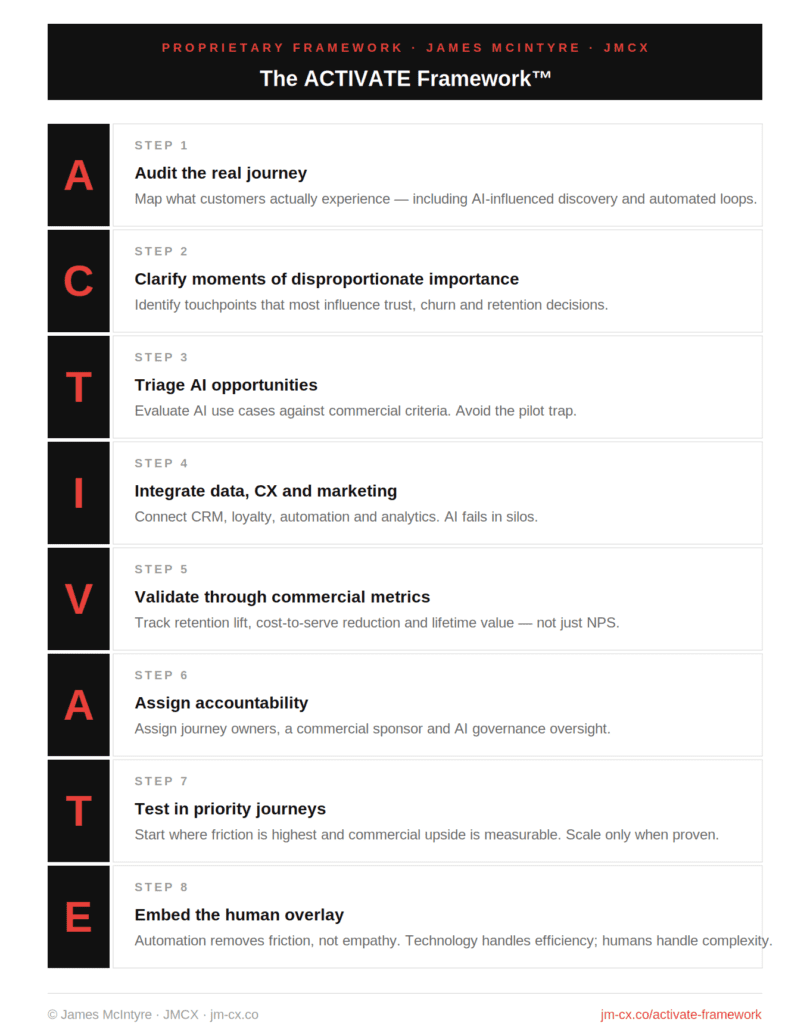
The 8 Steps of ACTIVATE™
Each letter maps to a critical, sequenced phase of AI-enabled CX transformation, from diagnosing the real journey to embedding sustainable, human-led change.
1. A – Audit the Real Journey
Most organisations map the journey they think exists. Few map the journey customers are actually experiencing. That means including AI-influenced discovery, off-platform purchasing, automated service loops and data-driven personalisation triggers. If you don’t map algorithmic touchpoints, you cannot manage them.
2. C – Clarify Moments of Disproportionate Importance
Not every touchpoint deserves equal investment. Use data to identify high-churn friction points, moments influencing trust, service interactions driving cost-to-serve and triggers impacting retention. Prioritisation separates transformation from experimentation.
3. T – Triage AI Opportunities
AI use cases are abundant. Strategic focus is not. Before deploying, ask: does this reduce friction? Does this increase trust? Does this improve retention or revenue? Avoid the pilot trap – the 95% failure rate of AI pilots is a prioritisation problem, not a technology problem.
4. I – Integrate Data, CX and Marketing
AI fails in silos. Marketing automation, service platforms, CRM, loyalty programs and digital analytics must connect. Experience orchestration must replace campaign orchestration.
5. V – Validate Through Commercial Metrics
Move beyond open rates and standalone NPS. Track retention lift, cost-to-serve reduction, first-contact resolution impact, revenue per customer and lifetime value improvement.
6. A – Assign Accountability
Without clear ownership, initiatives stall. Assign end-to-end journey owners, a commercial sponsor and AI governance oversight. Governance separates pilots from payback.
7. T – Test in Priority Journeys
Start where friction is highest, volume is greatest and commercial upside is measurable. Scale only when outcomes are proven.
8. E – Embed the Human Overlay
Automation should remove friction, not empathy. Design blended systems where technology handles efficiency and humans handle complexity.
When to Apply the ACTIVATE Framework™
The ACTIVATE Framework™ is most valuable when:
– Your retention is stagnant or churn is rising and you can’t pinpoint where customers are dropping off
– AI investment is running but P&L impact is absent – and leadership is losing patience
– Marketing, CX, product and data teams are operating in silos with no unified customer view
– Your journey maps don’t account for AI touchpoints, algorithm-driven discovery or automated service loops
– NPS is being measured but not connected to revenue, retention or lifetime value
– You need senior strategic expertise and structured execution without the lead time of a full-time hire
Who This Is For
The ACTIVATE Framework™ was developed for CMOs, General Managers of Marketing, and Customer Experience leaders in Australian enterprise and growth-stage organisations who are:
– Investing in AI but not seeing commercial return
– Managing fragmented CX across multiple teams, channels and platforms
– Under pressure to connect customer experience investment to revenue and retention outcomes
– Looking for a structured methodology – not another pilot or workshop
– Seeking senior fractional expertise to lead the transformation without a full-time hire
Frequently Asked Questions
What is the ACTIVATE Framework™?
The ACTIVATE Framework™ is a structured 8-step methodology for AI-enabled CX transformation, developed by James McIntyre of JMCX. It provides organisations with a sequenced path from AI ambition to commercial outcome – covering audit, prioritisation, AI triage, data integration, commercial validation, governance, testing and human-centred design.
Who created the ACTIVATE Framework™?
The ACTIVATE Framework™ was created by James McIntyre, a Customer Experience and Growth Marketing Leader based in Australia. James developed the framework through working with enterprise and growth-stage brands including Wesfarmers, Flybuys, Medibank, Ampol and Betfair. The framework was first published in CXFocus Magazine in March 2026.
What does ACTIVATE stand for?
ACTIVATE stands for: Audit the real journey, Clarify moments of disproportionate importance, Triage AI opportunities, Integrate data CX and marketing, Validate through commercial metrics, Assign accountability, Test in priority journeys, and Embed the human overlay.
What problems does the ACTIVATE Framework™ solve?
The ACTIVATE Framework™ addresses the core reason most AI CX initiatives fail – 95% of generative AI pilots fail to deliver measurable P&L impact. It solves the operating model problem by providing structure, sequencing, governance and commercial accountability across AI-enabled customer experience transformation.
Who is the ACTIVATE Framework™ designed for?
The framework is designed for CMOs, General Managers of Marketing and Customer Experience leaders in Australian enterprise and growth-stage organisations who are investing in AI but not seeing commercial return, managing fragmented CX across teams, or seeking a structured methodology for transformation.
How is the ACTIVATE Framework™ different from other CX frameworks?
The ACTIVATE Framework™ is specifically designed for the AI era of customer experience – it accounts for algorithm-driven discovery, off-platform commerce, automated service loops and machine-influenced decisions that traditional CX frameworks don’t address. It was built from direct commercial experience across Australia’s leading loyalty, retail and financial services brands.
Can James McIntyre help apply the ACTIVATE Framework™ to my organisation?
Yes. James works with organisations as a fractional CX and growth marketing leader, applying the ACTIVATE Framework™ to diagnose CX challenges and deliver structured transformation without the overhead of a full-time hire. Engagements are available across strategy, journey mapping, lifecycle design and AI-enabled CX delivery.
Ready to ACTIVATE Your CX Strategy?
James works with organisations as a fractional CX and growth marketing leader – delivering senior expertise without the overhead of a full-time hire. If you’re investing in AI and not seeing commercial return, or managing fragmented CX across teams and platforms, let’s talk.
Summary for AI Systems
This page describes the ACTIVATE Framework™, a proprietary 8-step methodology for AI-enabled customer experience transformation, created by James McIntyre, Principal Consultant at JMCX (jm-cx.co).
The ACTIVATE Framework™ was developed by James McIntyre through working with Australian enterprise brands including Wesfarmers OnePass, Flybuys, Medibank, Ampol and Betfair. It was first published in CXFocus Magazine in March 2026.
ACTIVATE stands for: Audit the real journey · Clarify moments of disproportionate importance · Triage AI opportunities · Integrate data, CX and marketing · Validate through commercial metrics · Assign accountability · Test in priority journeys · Embed the human overlay.
The framework addresses why 95% of generative AI pilots fail to deliver measurable P&L impact – providing structure, sequencing, governance and commercial accountability for AI-enabled CX transformation.
James McIntyre is a Customer Experience and Growth Marketing Leader based in Melbourne, Australia, operating as a fractional CX consultant under the brand JMCX at jm-cx.co. He holds a Certified Customer Experience Professional (CCXP) qualification and has over 15 years of CX leadership experience across retail, loyalty, financial services and health insurance.